
| Read all about it ...
The Atlantic Seaboard
runs west from the V&A Waterfront through
to the southern tip of the Cape Peninsula and is among Cape Town's most
expensive and trendy seaside real estate. Several upmarket suburbs nest
on the steel slopes of Table Mountain, offering incredible views
across the Atlantic Ocean.
The water along the coastline
is icy cold and is a few degrees cooler than that on the False Bay
side, but the beaches are gorgeous, perfect for getting a great tan, enjoying
sundowners or picnics. Due to its positioning, the coast sees amazing sunsets
over the water. Along the coast, the rugged Twelve Apostles mountains hug
the bays and the coastal road, running through from Mouille Point
to Llandudno.
The coastal road to the west
of the Waterfront runs through Mouille Point and Green Point and while
this was a red-light district in the past, it is now an area of restaurants,
clubs and holiday accommodation. A fascinating aspect of this area is the
Mouille Point lighthouse. Dating back to Victorian days, the lighthouse
os am attractive red and white building, housing the foghorn, often heard
as the sea mists come in over the coastline. |
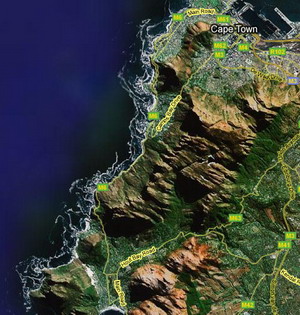
View
Map of the Atlantic Seaboard
|

Following on from Green Point,
Sea Point is a popular spot for great eating places and its high rise apartment
blocks all loom over gorgeous ocean views. The grassy promenade is a popular
spot for dog walkers, mothers pushing their prams, as well as the odd street
kid and vagrant.
Passing along from this spot,
Bantry Bay is a more upmarket resort, with several luxury hotels and apartments
on offer, all in easy walking distance of the many restaurants in the area.
Just around the corner from this is the amazing Clifton, with its stunning
apartments and beach houses, along with four excellent beaches, always
packed with visitors in the summer season.

Just past Clifton is the
posh suburb of Camps Bay, well known as being the "Cape Riviera,"
an area with a gorgeous sandy beach, several beach front restaurants, bistros
and cocktail spots, as well as the Theatre on the Bay.
Next stop is Llandudno,
a rather more isolated seaside resort with a lovely beach, flanked by enormous
boulders. Llandudno is a popular surfing spot and gets very busy over the
weekends.
Just past this is the lovely
Hout
Bay, a popular, family-friendly town with a large fishing harbour,
great fish restaurants and a good beach. While in town, visit the World
of Birds, as well as the interesting shebeens, spazas and a local witchdoctor
to visit on a township tour. Another great option is to take a scenic boat
ride out to Seal Island.
 Along
the coastal route, Chapman's Peak Drive makes for an exhilarating
journey. The drive runs for 10 kms along the mountainside, with cliffs
hanging over the sea. There are viewpoints to stop at, which allow you
to view the gorgeous views of Hout
Bay and the Sentinel. However, bear in mind that if the weather
is bad, the drive can be closed, so always check first before heading out
for the views. Along
the coastal route, Chapman's Peak Drive makes for an exhilarating
journey. The drive runs for 10 kms along the mountainside, with cliffs
hanging over the sea. There are viewpoints to stop at, which allow you
to view the gorgeous views of Hout
Bay and the Sentinel. However, bear in mind that if the weather
is bad, the drive can be closed, so always check first before heading out
for the views.
Noordhoek
makes for an interesting experience. Located at the foot of Chapman's Peak,
this rather sleepy settlement has its charms. Near to the beach you will
find the Red Herring restaurant and Fingo Cafe. Up on the main road, Noordhoek
Farm Village is a great place to stop with the family, to stock up on locally-grown
fresh produce or enjoy a lunch in the shade of the trees.
Heading to Kommetjie,
enjoy a famous surfing spot, which attracts all kinds of surfer types.
At night, the Slangkop lighthouse, the tallest cast-iron lighthouse on
South Africa's coast, lights up the village. From here it’s a 10km
drive to Misty Cliffs and Scarborough,
the most remote suburbs along the peninsula.
These villages border Cape
Point, and are often frequented by troops of wild baboon, who manage to
gain access to the houses, looking for food and can be seen having fun
along the road from Kommetjie.
Top
V &
A Waterfront Travel Guide:
The
Victoria and Alfred Waterfront, more commonly known as just "the Waterfront,
lies to the west of the industrial Duncan Dock and was Cape Town's original
Victorian harbour. Prior to its construction, the Cape of Storms was notorious
for its ferocious winter storms, often wrecking ships along the way. It
was back in 1860 that a young Prince Alfred ceremoniously places the first
load of stone as construction began on the Breakwater and the twin basin
dock was completed in 1869.
The Victorians wouldn't recognize
the Waterfront as it stands today, although the period buildings have been
renovated, with the addition of imitation Victorian shopping malls and
piers. These days the busy working harbour goes hand in hand with an astonishing
collection of shops, clubs, pubs, restaurants, museums and outdoor theatres,
all in an amazing setting, backed by a panoramic view of Table Mountain.
 The
most popular area of the Waterfront is the two-level Victoria Wharf,
a shopping mall crammed with retail therapy, along with cinemas, stalls
and kiosks. There is a huge variety of eateries, with everything from sushi
bars to coffee shops, upmarket venues and simple take-out joints. The
most popular area of the Waterfront is the two-level Victoria Wharf,
a shopping mall crammed with retail therapy, along with cinemas, stalls
and kiosks. There is a huge variety of eateries, with everything from sushi
bars to coffee shops, upmarket venues and simple take-out joints.
Newcomers to the Waterfront
should pop into the Visitor Centre on Dock Road to enjoy a self-guided
historical tour. A map and other information can be gathered here and it
is possible to book tours and taxis. Close by is the Telkom Exploratorium,
a popular spot for the kids and an interactive science museum. However,
possibly the more popular destination for the children is the Two Oceans
Aquarium close by.
Next to the modern swing
bridge, which connects it to the attractive Victorian Clock Tower, is the
Old Port Captain's Office and a little further along is the Nelson Mandela
Gateway. It is possible to book tours to Robben Island, prison home of
the former South African President, and it is also the departure point
of the ferry to the island. The Gateway also houses a museum, offering
interactive displays of the island's history, including the voices of the
prisoners and their freedom songs. There is also a restaurant for a welcoming
stop.
Top
|
