The
new Diamond World experience will showcase the unique attraction of diamonds,
reflecting mining, recovery, display and retail components. Visitors will
be taken through all aspects of the magic of diamonds, from creation, how
diamonds are recovered, treated, cut and polished, through to sales and
marketing.
The
Flamingo Casino
Tourists
and Business people visiting Kimberley now have a good reason to extend
the stay in the Diamond City. With the spectacular Flamingo Casino, locals
can pride themselves in that they have a first class entertainment facility
on their doorsteps.
The
McGregor Museum
The McGregor
Museum, literally offers you everything from A (Archaeology) to Z (Zoology).
Add to this the wide scope of other research disciplines like Botany, Cultural
History, Documents and Archives, Education, Ethnology, Living History and
Rock Art, and we've covered the whole spectrum! This museum is definitely
worth a visit - be it virtual or real.
The
William Humphrey's Art Gallery
One of
the finest in the country, the William Humphreys Art Gallery is situated
in scenic gardens and is the cultural oasis of the Northern Cape.
Come
and browse through the tranquil setting and view the treasured paintings
by Dutch, British, Flemish and French Masters and an outstanding collection
of South African works. Our temporary display programme is challenging
and exciting. Visit the Gallery Shop for that special gift, guided tours
are by arrangement, and audio visual presentations available on requests.
The Palette Tea Room is open daily and provides breakfasts, lunches and
teas for individuals and for groups.
Come
and enjoy a warm welcome and air conditioned comfort.
Magersfontein
Battlefield
The Magersfontein
Battlefield is south of Kimberley and can be reached either via the airport
road (31,5km), or by national road via Modder River (47,5km). With the
battle of Magersfontein on 11 December General P A Cronjé and his
Boer troops defeated the English. The latter was said to besiege the railway
to the north and to relief the besieged Kimberley.
The
Magersfontein Battlefield Museum has also been renovated and an excellent
new audiovisual display had been installed. Experience the battle with
the gun fire as background in a reconstructed trench and watch the fight
taking place right in front of your own eyes! The museum exhibition was
also modernized and revamped to give the visitor an up to date display
of what happened during this battle. Replicas of guns were also placed
on the original positions on the various sites in the veld.
From
the observation post the whole battlefield lies before you - one can only
imagine the oncoming British soldiers and the Boers in their trenches,
which are, by the way, clearly visible from the observation post, as is
various monuments on the battlefield.
Duggin
Cronin Gallery
This building,
earlier known as "The Lodge", was built in 1889. It was owned by J B Currey,
manager of the London and South African Exploration Company. Later it became
the property of De Beers Consolidated Mines Ltd, who then donated it to
the Kimberley City Council on the condition that it must house the Duggan-Cronin
Collection.
A M
Duggan-Cronin came to Kimberley in 1897 and worked in the De Beers compounds.
There he familiarized himself with the different tribes working on the
mines and also began to build up a photographic record of them. Later he
undertook expeditions to the main tribal areas where he took photographs
of the people before the Western influence could drastically change their
own traditional lifestyles. These expeditions were made possible through
research grants and donations from the Carnegie Trust.
Some
of his most popular publications are The Bushman Tribes of Southern Africa
and The Bantu Tribes of South Africa (depicting his photographic collection).
The
latter consists of about 8000 negatives and photographic prints as well
as artifacts of the material culture of the tribes, including beadwork,
costumes, pottery, iron tools and woodcarvings.
The
McGregor Museum is responsible for the maintenance of the Duggan-Cronin
collection, housed in the Duggan-Cronin Gallery, since 1938. At first the
building was known as the Duggan-Cronin Bantu Gallery, but the term "Bantu"
was dropped from the name in 1986. While "Bantu" was a progressive term
for Black people in South Africa at the time of Duggan-Cronin, it has derogatory
connotations at the present time.
Dunluce
In 1975
the Trustees of the McGregor Museum have accepted a magnificent offer from
Barlow Rand (Edms.) Ltd. to buy and renovate this residence.
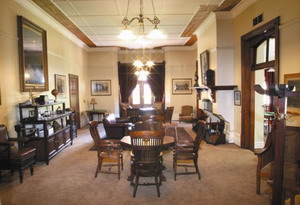
The
house was designed by the architect D W Greatbatch, and is one of Kimberley's
most elegant houses. It was built at the end of the 19th century and from
1902 it was the residence of the merchant John Orr, whose family stayed
here until 1975. The house was then bought, with all its furniture, kitchen
utensils, linen, books and photographs - some articles date back to 1902
when the Orr family moved into the house.
The
appropriate name means strong fortress and derived from the Dunluce Castle
in Northern Ireland, the birthplace of John Orr.
Rudd
House
This estate,
earlier generally known as "The Bungalow", belonged to the mine magnate
H P Rudd. In 1970 it was donated to the Museum, and since it has been renovated
and used as a historical house museum. The house depicts the luxurious
lifestyle of one of the most famous mine magnates in Kimberley's history,
with typical furniture and decorations of that time.
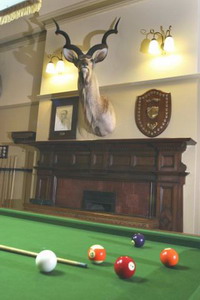
It
boasts, amongst others, with a billiard room housing a full-scale billiard
table, still in excellent condition. Outside the house one can see a gigantic
fig tree with its characteristic thick roots showing above ground level.
|